
The Journey to the Front of the Classroom
I find education fascinating.
From Montessori to Steiner, to traditional state-funded education, everyone seems to have an opinion on what is best. Some swear by phonics, others project-based learning. Some believe children should wear uniforms; others think they should spend half the day climbing trees.
Everyone has their view.
What has fascinated me recently, isn't how children are taught. It's how teachers get there in the first place.
If you're a parent, have you ever stopped to ask yourself why that particular adult is standing in front of your child's class?
In this post, I want to compare England and France, not in terms of teaching methods, but how teachers actually get their jobs.
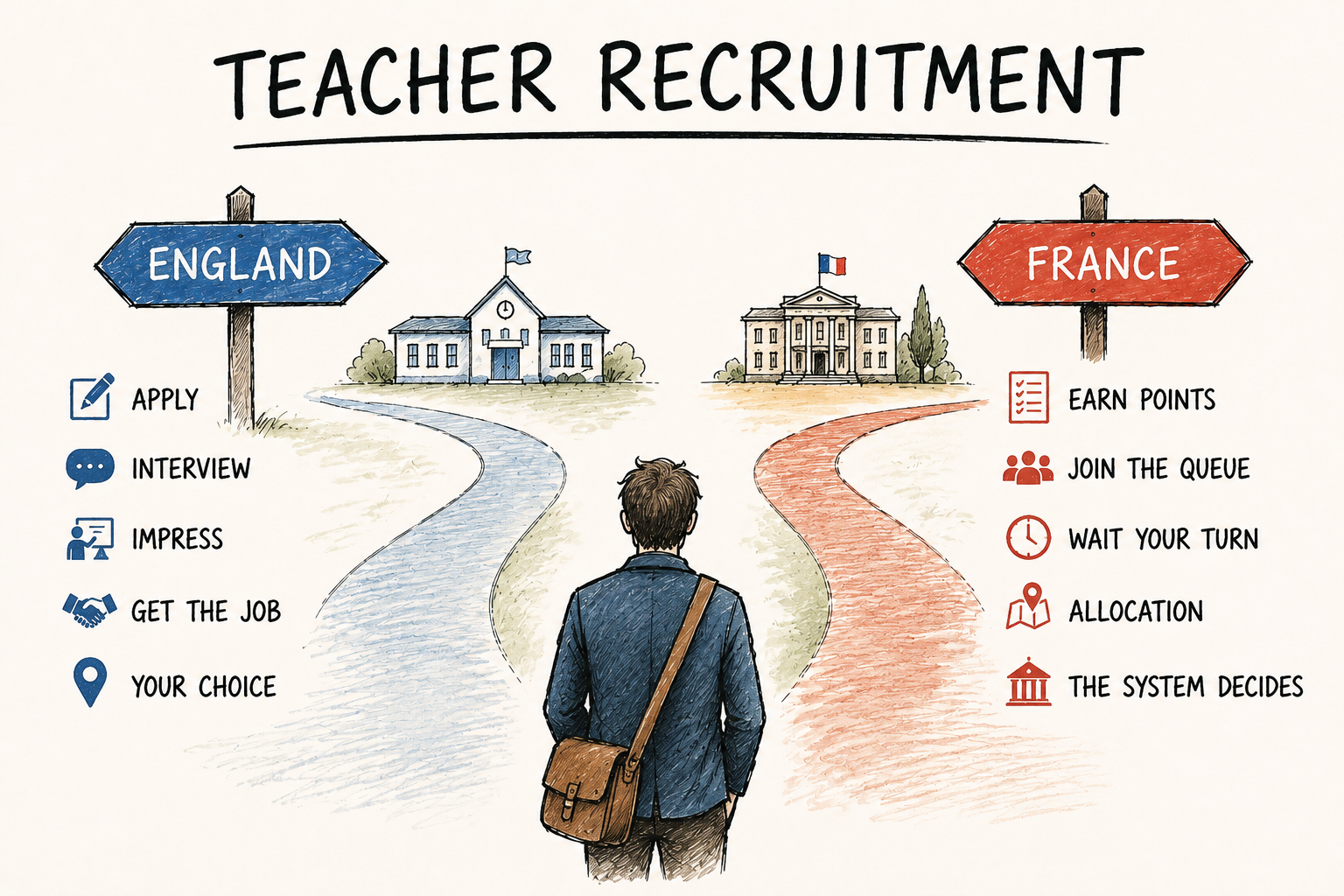
England or France. Teacher routes into education
Becoming a Teacher in England
England has several routes into teaching.
Undergraduate teaching degree
PGCE
School Direct
SCITT (School-Centred Initial Teacher Training)
Teach First
Some routes are more academic. Others throw you into the classroom from day one. Some are paid, others require you to survive for a year on coffee and overdrafts.
Whichever route you take, you eventually gain Qualified Teacher Status (QTS), allowing you to apply for teaching jobs anywhere in England.
From there, it works pretty much how you'd expect.
Schools advertise jobs.
Teachers apply.
Candidates are shortlisted.
There are interviews, lesson observations, safeguarding questions, tours of the school where everyone tries to pretend they're not judging each other, and eventually someone gets offered the job.
Becoming a Teacher in France
France does things rather differently.
The usual route is:
Complete the required university degree (normally a Master's).
Pass a national competitive examination known as the concours.
Complete a training year.
Become a fonctionnaire- a civil servant.
All kind of the same so far…
But this is where things become interesting.
Once qualified, teachers don't simply apply wherever they fancy.
Instead, France uses a national points system called the barème.
Think of it as joining a very long queue.
The more points you have, the more choice you have over where you work.
You earn points for things like:
Years of service
Working in difficult schools
Having a spouse living in another area
Having children
Living with a disability
Repeating the same transfer request year after year
Holding certain specialist roles
It's a system designed to be transparent and fair.
Two Different Ways of Thinking.
Before deciding which system is better, I think it's worth recognising that England and France aren't really trying to solve the same problem.
In England, schools recruit teachers.
In France, the state allocates teachers.
That might sound like a small difference, but philosophically it's enormous.
The English system treats teachers like professionals operating in a job market. Schools choose who they want. Teachers choose where they apply. Success depends on interviews, experience, references and whether everyone thinks you'll fit the school.
The French system treats teachers as civil servants. The aim is to reduce subjectivity and make appointments according to nationally agreed rules. Teachers can be placed anywhere in their department.
Neither system is irrational.
They're simply built on different ideas.
The Positives of the French System
It reduces favouritism.
It rewards experience.
Teachers willing to work in difficult schools are recognised.
Family life matters. If your husband, wife or partner lives hundreds of miles away, the system tries to help reunite you.
Most importantly, everyone knows the rules.
Nobody can quietly give a job to their mate from university.
The Negatives
Of course, every system creates its own problems.
The teacher who is the best fit for a particular school might not get the job.
Schools can't always build the team they want.
New teachers often have very little say over where they begin their careers.
Points start to matter more than personalities.
Bureaucracy- someone has to deal with those transfer requests
My Thoughts
The longer I live in France, the more I notice the cultural differences between our two countries.
France is built on the ideals of Liberté, Égalité, Fraternité. Those three words sit quietly underneath almost everything the country does.
After the Second World War, the French Civil Service was built around ideas of equality, neutrality and national careers. Over the following decades, the teacher allocation system gradually became more detailed, with years of service, family circumstances, disabilities, priority schools being added.
Then computers arrived. Centralisation’s dream.
Now every teacher could be ranked nationally.
Ironically, the more categories you introduce to make something fair, the more unfair it gets and the more complex it gets too.
No wonder France has a reputation for bureaucracy.
The only thing that arrives on time is lunch.
Turn up to a restaurant too early? It's closed.
Turn up too late? They'll politely tell you you've missed your chance.
England has gone in the opposite direction. With all day breakfasts, 24hr supermarkets and shops open on Sunday (and Monday….for those living in Pau, France).
Competition, school autonomy and local decision making are the guiding principles.
Although I do think academies and free schools have complicated that picture. Schools are under enormous financial pressure, and recruiting an experienced teacher can cost significantly more than employing someone newly qualified.
Money has a way of influencing what we call "merit."
Whenever I've been interviewed by a school, I've always reminded myself that I'm interviewing them as much as they're interviewing me.
Will I fit the school?
Will the school fit me?
The power a headteacher has to build a team shouldn't be underestimated.
I'm sure you've worked somewhere with a brilliant manager or an awful one.
One workplace makes you excited to come in on Monday morning.
The other has you checking job websites by Wednesday lunchtime.
Teaching is no different.
So Which System Is Better?
I'm not convinced there is a right answer.
The English system gives schools more freedom, but also more opportunity for bias.
The French system gives teachers more protection, but often less freedom.
One trusts people.
The other trusts rules.
Both are trying to educate children.
They're just taking very different roads to get there.
The Reflection of Society
A few blog posts ago, I wrote Shorter Holidays and More Time in School! In it, I predicted that school holidays would become shorter or the school day would become longer.
At the time, I wasn't really writing about education.
I was writing about society.
The more I think about schools, the more I believe they reflect the society they exist in. Schools rarely change first; society changes, and schools adapt.
If parents are working longer hours, schools gradually become providers of childcare as well as education.
If governments become more centralised, education often becomes more centralised too.
Teacher recruitment is another example of this.
The English system reflects a society that values competition, flexibility and local decision-making. Schools recruit their own staff because they're expected to compete, manage their own budgets and build their own teams. There is freedom, but with that freedom comes financial pressure, inconsistency and the possibility of bias.
The French system reflects something quite different. It places greater trust in the state to organise public services through nationally agreed rules. Points, examinations and national policies create a system designed to treat teachers consistently rather than leaving decisions entirely to individual schools.
Neither approach appeared by accident.
Both are products of the societies that created them.
Perhaps that's why I find education so fascinating.
It isn't just about teaching children to read, write or solve equations.
If you want to understand a country, don't just look at its politicians or its economy.
Look at its schools.
They quietly reveal what that society believes is worth protecting, rewarding and passing on to the next generation.
