
A student's failure is a teacher's paycheck.
By writing this, I am condemning myself.
By writing this, I am exposing the hypocrisy of a system that also pays my bills.
I hope that by writing this I am being more honest, with myself and with others.
Recently, I had a call with a parent who asked whether the Year 6 SATs were important.
I replied, "No."
Their child was struggling in class. The child’s confidence had reached an all-time low, and stress levels at home were rising. The school's advice?
"Get a tutor."
There was little else they could offer.
This is where I step in.
Helping struggling students is my speciality.
Their struggle pays my rent.
Failure
When I was eight years old, my teacher placed two room dividers either side of my desk so I could concentrate on him. At the time I laughed, but it became one of those core memories that never leaves you.
Looking back, I understand why he did it. He had no classroom support, twenty-five other children to teach, and one boy who couldn't sit still, never mind keep his eyes facing forwards.
I failed that year.
In fact, I probably failed every year.
At boarding school I attended extra tutoring sessions where I became so frustrated that I started pulling my hair out.
Eventually I scraped through my GCSEs, scraped through my A Levels, a degree, and later qualified as a teacher.
So did I fail?
Or did I succeed?
Those experiences shaped the teacher I became. They taught me empathy, patience and understanding for children who don't fit neatly into the education system.
That has become one of my greatest strengths.
But let's not kid ourselves.
Education celebrates success.
It survives on failure.
A System Built on Standardisation
Schools have to educate millions of children every year, so standardisation makes sense.
Children start school according to the Georgian calendar rather than their readiness, maturity, interest or any other possible way of organising groups. They follow the same curriculum, learn the same content and are assessed against the same expectations.
Standardisation makes schools easier to organise, easier to compare and easier to measure.
But it also creates winners and losers.
Throughout fifteen years of education, children are constantly assessed.
Year 2 phonics checks.
Year 6 SATs.
11+ exams.
End-of-unit tests.
End-of-term tests.
GCSEs.
A Levels.
At every stage there is another benchmark waiting.
And with every benchmark comes the possibility of failure.
The Unintended Consequences
Stress is one of the unintended consequences of this system.
Even high-achieving students feel pressure to maintain their grades.
For struggling students, the consequences are much deeper.
Confidence disappears.
Anxiety grows.
School becomes something to survive rather than enjoy.
Parents feel it too.
If your child comes home every day crying about school, tests or feeling stupid, what do you do?
Most parents look for a solution.
Some arrange meetings with teachers.
Some hire tutors.
Some tell their child that the tests don't matter.
I've lost count of the number of parents who have told me,
"I disliked school too."
"My child is just like me."
For many children, school doesn't simply teach maths and English.
It teaches them that they're not good enough.
Those feelings often last far longer than the tests themselves.
Year 6 SATs
Am I against assessing children?
No.
Assessment can be incredibly useful.
Good assessments tell teachers where children need support and help identify gaps in learning.
The problem is that SATs have become something they were never intended to be.
Officially, SATs exist to:
identify learning gaps;
support transition to secondary school;
measure school performance.
The first reason makes sense.
Assessment should inform teaching.
But in reality, how much opportunity is there to revisit concepts once the curriculum has moved on?
Teachers already struggle to cover everything they're expected to teach.
The second reason is weaker.
Most secondary schools assess pupils again when they arrive in Year 7.
Many teachers spend the first few weeks revisiting Key Stage 2 content anyway, because so much of Year 6 becomes focused on preparing for SATs rather than securing long-term understanding.
The third reason is where the real pressure comes from.
SATs measure schools.
School performance tables matter.
Inspection outcomes matter.
Leadership teams feel that pressure.
Teachers feel that pressure.
Eventually the children feel it too.
Walk into most Year 6 classrooms during the summer term and you can feel it immediately.
Practice papers.
Revision sessions.
Countdown clock on walls..
A room full of ten and eleven-year-olds carrying the weight of a system far bigger than themselves.
A Game Everyone Plays
Everyone involved is acting rationally.
Parents hire tutors because they want to help their child.
Teachers teach (somewhat) to the test because they're judged on results.
School leaders focus on data because inspections demand accountability.
Tutors help struggling children because those children genuinely need support.
No individual is acting maliciously.
Yet together we create a system that produces stress, anxiety and a growing demand for private tuition.
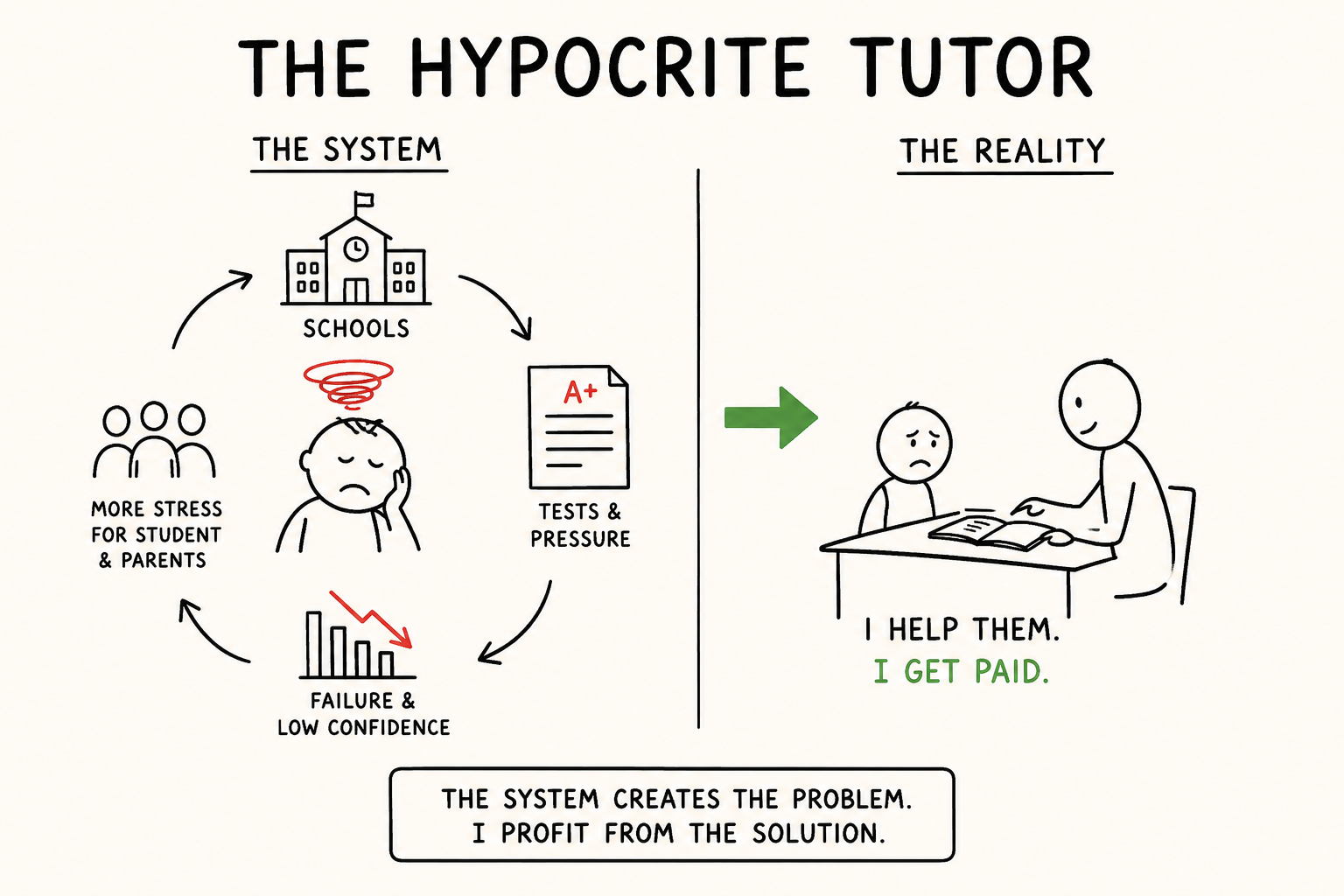
The system creates the very conditions that keep tutors like me in business.
The Hypocrisy
So...
Are Year 6 SATs important?
Not really.
Will they define a child's future?
Almost certainly not.
But they matter enough to create fear.
Fear creates demand.
Demand creates work.
And that's where I come in.
Every struggling child who can't get enough support in a classroom of thirty-two pupils eventually finds their way to someone like me.
I genuinely want to help them.
But I also benefit from the system that failed them in the first place.
That is the contradiction I live with. And, I want to change.
I don't believe tutoring is the problem.
In many cases, it is the solution. One to one help goes such a long way! I always get messages from parents at the end of the term sharing me their SATs results and saying how much I have helped their confidence.
The real question is why so many families need that solution in the first place.
What I am trying to say here is that it does not have to be the case. But, changing the system is easier said than done.
Which brings me to two questions that I think education has forgotten to ask.
What are schools for?
Why are we learning?
I don't blame teachers.
I don't blame school leaders.
I don't even blame the system.
Every person within it is responding to the incentives placed in front of them. And no one has the incentives to change it,
why……
….because we all get paid.
But perhaps that's exactly the problem. And that's what I'll explore in the next post.
The incentives of the education system.
